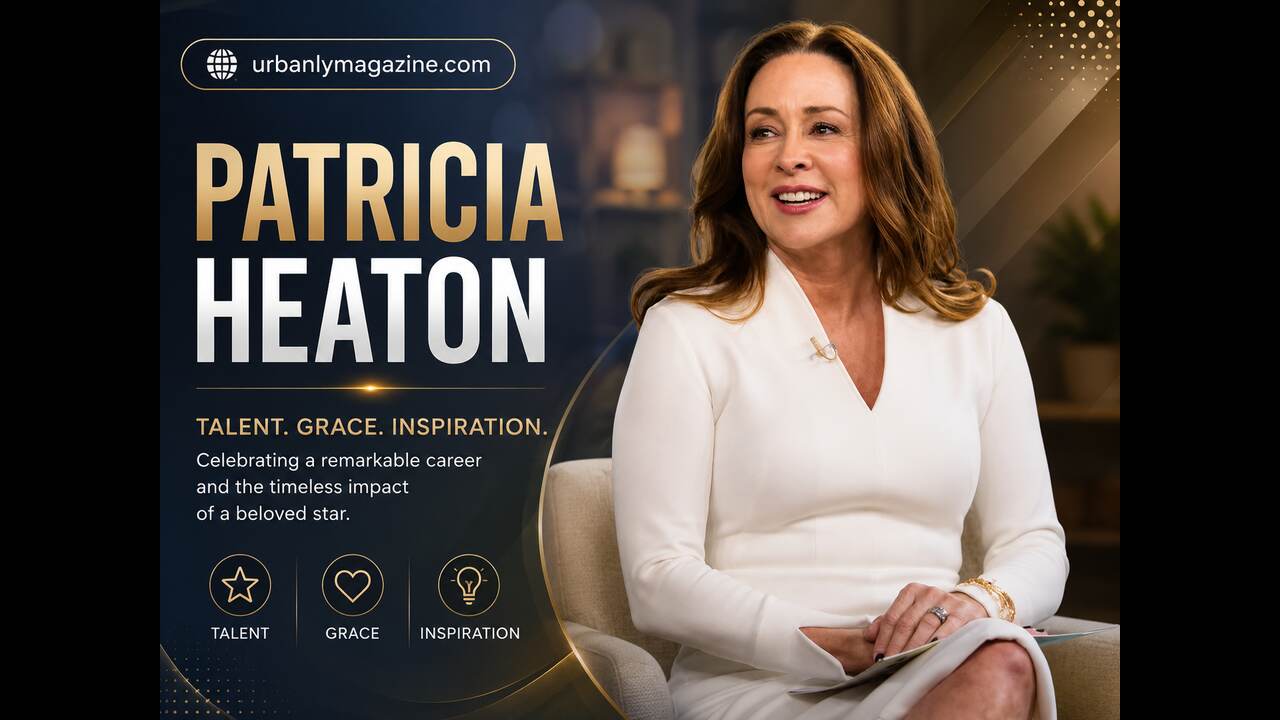
If you were anywhere near a television in the late 1990s, there’s a good chance you knew her face long before you knew her name. She was the exasperated, funny, endlessly patient wife rolling her eyes at her in-laws every Monday night on CBS. Millions of people felt like they knew her personally, even though most of them had never once heard the name Patricia Heaton.
That gap between the character and the woman behind her is where this story actually starts. Patricia Heaton’s own life turns out to be just as interesting as anything her characters ever went through small-town Ohio roots, a hard string of almost-broke years, personal loss, faith, a stubborn sense of humor, and a career built less on one lucky break than on refusing to quit after several near-misses.
Two different generations of TV audiences have their own version of her. If you grew up in the late 90s, she’s Debra Barone. If you grew up a decade or two later, she’s Frankie Heck. Ask either group who Patricia Heaton actually is once the cameras stop rolling, and most people would come up empty. That gap is exactly what makes her real story worth telling.
Who Is Patricia Heaton?
Patricia Heaton is an American actress, producer, and author best known for playing Debra Barone on “Everybody Loves Raymond” and Frankie Heck on “The Middle.” She’s a three-time Emmy winner, a bestselling author, and as of 2026, at 68 years old still very much working, with a new legal drama pilot and a growing non-alcoholic wine business alongside her husband. Slowing down has never really seemed to be part of her plan. But she didn’t start out anywhere near Hollywood. She started out in a small lakeside town in Ohio, in a house full of kids, with a sportswriter for a father, in a story that took its first hard turn before she’d even finished grade school.
Growing Up in Bay Village, Ohio
Patricia Helen Heaton was born on March 4, 1958, in Bay Village, Ohio, a quiet suburb on the shore of Lake Erie just outside Cleveland. Her father, Chuck Heaton, spent decades as a sportswriter for The Plain Dealer, and her mother also named Patricia kept a household of five kids running. Patricia was the fourth of the five, with three sisters and one brother. Bay Village in the 1960s was the kind of place where neighbors knew each other by name, church on Sunday was simply what people did, and a big, loud household like the Heatons’ was fairly ordinary just one more crowded family among many along that stretch of the lake.
Then, when Patricia was only 12 years old, her mother died suddenly of a brain aneurysm. It’s the kind of loss that reshapes a childhood, and by every account, it did. She was raised the rest of the way in a devoutly Catholic household, one that leaned even harder into faith and family after that loss and both of those things, faith and family, have stayed close to the center of how she talks about her life ever since.
It’s worth sitting with that for a second, because it’s easy to skim a résumé and jump straight to the fame. Long before any Emmy nomination, Patricia Heaton was a kid from Ohio who lost her mom and kept going. That kind of early resilience doesn’t show up on a highlight reel, but it tends to show up in how a person handles everything that comes after.
Finding Her Voice: Education and the Long Road to Acting
Ohio State and a Degree in Drama
Heaton stayed close to home for college, studying drama at Ohio State University, where she joined the Delta Gamma sorority. One summer, she interned at an ABC affiliate in Cleveland, editing news film. It’s a small detail, but it says something about her: nobody handed her a path into show business. She built one, one unglamorous job at a time.
Training in New York and a Broadway Debut
After graduating in 1980, Heaton did what a lot of serious young actors did back then she packed up for New York City and trained under the well-known acting coach William Esper. It took another seven years before she made her Broadway debut, in 1987, in the gospel musical “Don’t Get God Started.” She was closer to thirty than twenty at that point, and still very much building a career from the ground up, one small role at a time.
The Long Road Before Everybody Loves Raymond
Here’s the part of Patricia Heaton’s story that tends to get skipped over: the near-decade of guest spots, small parts, and short-lived shows that came before anyone outside the industry knew her name.
She landed a recurring role on the acclaimed drama “thirtysomething,” small parts in films like “Beethoven,” “Memoirs of an Invisible Man,” and even “Space Jam” alongside Michael Jordan and a cast of Looney Tunes characters, plus a run of sitcoms that never made it past a season or two “Room for Two,” “Someone Like Me,” “Women of the House.” None of them turned her into a household name. Most people watching television in the early 1990s couldn’t have picked Patricia Heaton out of a crowd, and there was no guarantee any of it was leading anywhere.
That stretch of a career rarely comes up in interviews, because “nine years of small parts before my big break” doesn’t make for as tidy a story as “overnight success.” But it’s the far more common version of how a career in this industry actually goes, and it’s worth remembering the next time a new face seems to appear out of nowhere.
But “Room for Two” gave her something that mattered more than ratings: a mentor. The show starred Linda Lavin, already a household name from “Alice,” with Heaton playing her daughter. Decades later, after Lavin passed away in December 2024, Heaton posted a heartfelt tribute describing everything she’d learned from her not just about acting, but about how to lead a set with kindness and treat every single person on it with respect, no matter their job. She’s said that watching Lavin work is something she has carried with her ever since, into how she treats people on her own productions. It’s the kind of detail that never shows up on a résumé, but it explains a great deal about the person Patricia Heaton became.
Patricia Heaton Big Break: Everybody Loves Raymond
In 1996, at 38 years old an age when plenty of actresses are quietly told the good roles are drying up Patricia Heaton landed the role that would define her career: Debra Barone, the sharp-tongued, long-suffering wife of sportswriter Ray Barone on CBS’s “Everybody Loves Raymond.”
The show ran for nine seasons, from 1996 to 2005, and became one of the most beloved sitcoms of its era, built almost entirely on the friction between Ray, Debra, and Ray’s overbearing parents, Marie and Frank, who lived directly across the street. Heaton’s Debra was never a pushover or a simple punchline. She was funny because she was believable a woman juggling three kids, a needy husband, and in-laws who never once knocked before walking in, and somehow keeping her sense of humor through all of it.
Audiences responded, and so did the Television Academy. Heaton picked up her first nomination in 1999, then won the Primetime Emmy for Outstanding Lead Actress in a Comedy Series in both 2000 and 2001, along with several more nominations across the show’s run. By 2006, Debra Barone had become such a fixture in American living rooms that one poll named Heaton the television personality viewers would most want as a real-life housewife an odd kind of compliment, but a genuine sign of how completely audiences had adopted Debra as someone they actually knew, rather than just a character on a screen.
“Everybody Loves Raymond” made Patricia Heaton a star in her late thirties and early forties, at a stage of life when Hollywood usually stops paying attention to actresses altogether. That timing is part of why so many people connect with her story people who suspect their own best chapter might still be ahead of them, not behind.
Life After Raymond: The Middle and Beyond
Most actors would happily coast on a role like Debra Barone for the rest of their career. Patricia Heaton went and built another one just as beloved.
In 2009, she took on the role of Frankie Heck, an overworked, underpaid car saleswoman raising three kids in the fictional town of Orson, Indiana, on ABC’s “The Middle.” The show ran for nine seasons, through 2018, and earned her a Critics’ Choice Television Award nomination. Where Debra Barone was sharp and put-together, Frankie Heck was scrappy, frazzled, and a little chaotic a completely different kind of TV mother, on a different network, in a different corner of the country. Following up one iconic role with another one just as loved is a hard thing to pull off, and Heaton made it look close to effortless.
Around and after those two shows, she kept working steadily: hosting and executive-producing “Patricia Heaton Parties” for the Food Network, which won her a Daytime Emmy for Outstanding Culinary Program, and starring in the CBS comedy “Carol’s Second Act” from 2019 to 2020, playing a woman who becomes a doctor in her fifties after her kids leave home. Whether by coincidence or design, that premise lines up almost perfectly with the real reinvention Heaton has pulled off more than once in her own life. She also turned that theme into a bestselling book, “Your Second Act,” about starting over and figuring out what comes next a subject she clearly knows something about firsthand.
Faith, Family, and What Matters Most to Patricia Heaton
Marriage, Motherhood, and a Very Specific Funeral Joke
Patricia Heaton married British actor and producer David Hunt in 1990, and the two have four sons together: Samuel, John, Joseph, and Daniel. By her own account, being a working mother of four boys has meant plenty of chaos and never quite enough sleep.
It’s also given her some of her best material. In one interview, she admitted, with total exasperation, that her own sons had never actually watched her on “Everybody Loves Raymond” nine full seasons, and not one of them had sat through it. Her solution, only half-joking, was to make them watch the entire series at her funeral, whether they liked it or not. It’s a small story, but it says a lot about how she talks about her own family: honestly, warmly, and without ever taking herself too seriously.
Faith and Public Advocacy
Heaton was raised Catholic and has continued to speak openly about her Christian faith throughout her career, including taking part in public Scripture readings such as “America Reads the Bible” in 2026. She has also served for years as honorary chair of Feminists for Life, an organization that approaches the pro-life movement from a feminist perspective. Whatever a reader’s own views on that particular issue, it’s a role she’s held for a long time, and one she describes as a genuine extension of her values rather than a passing talking point.
Over the years, she’s also made the rounds on major talk shows, from “The Late Show with David Letterman” to “Oprah,” and the same personality tends to show up in nearly all of those appearances: direct, a little irreverent, and not especially interested in performing some more polished version of herself for the cameras.
A New Chapter: Patricia Heaton in 2026
Even with a résumé most actors would consider a full career on its own, Patricia Heaton isn’t slowing down. In 2026, she’s executive producing and starring in “Public Interest,” a legal drama pilot alongside Richard Schiff and James Wolk, and she appeared in Amazon Prime Video’s romantic comedy “Merv.” She and Ray Romano have both confirmed there’s no “Everybody Loves Raymond” reboot coming, but the two have stayed close in the years since the show ended.
She’s also taken her own reinvention story in a new direction: alongside David Hunt, she launched Solubrae, a non-alcoholic wine brand built for people who want the ritual of a glass of wine without the alcohol. It’s a direct extension of her own choice to step back from drinking, made public in a way that feels less like a marketing angle and more like an honest continuation of the story she’s always told about herself someone who’s willing to change course the moment something stops serving her.
Earlier in 2026, she went viral for a much smaller reason: a social media post about an ordinary Saturday grocery run, filmed with long gray hair and full makeup, that fans immediately called glamorous for something so mundane. It’s a tiny moment, but it fits a pattern. In her late sixties, Heaton has never seemed particularly interested in the usual Hollywood rules about aging quietly out of view gray hair and all, she’s still willing to let people see her, unfiltered, off-camera.
She’s even kept a small, literal foothold in the town where her story began: she’s a part owner of an Italian restaurant next to the community theater in Bay Village, a quiet reminder that Ohio never really let go of her, even after decades of building a life in Los Angeles.
What Patricia Heaton Story Can Teach Us
It’s tempting to read a celebrity biography as a highlight reel, but the genuinely useful part of Patricia Heaton’s story isn’t the Emmys sitting on a shelf somewhere. It’s everything that happened before them.
She lost her mother at 12 and kept going. She spent close to a decade in forgettable shows before landing the role that made her a household name, at an age when the industry usually tells women their moment has already passed. She built a second iconic character after the first one could easily have been an impossible act to follow. And now, in her late sixties, she’s still starting new projects, still building new things, still willing to be a beginner again.
None of that happened in isolation, either. The mentorship she got from Linda Lavin, on a show almost nobody remembers, shaped how she treats people on set today. The sense of humor that makes her joke about forcing her sons to sit through her entire back catalog at her funeral is the same one that carried her through nearly a decade of overlooked auditions. Even Solubrae, a wine company, traces back to a personal decision about her own health, made public because she’s never seemed especially interested in hiding the less polished parts of her life. The individual pieces of Patricia Heaton’s story keep turning up again inside each other, which is usually a decent sign that a life is being lived with some real consistency, rather than just performed for an audience.
That’s the real throughline of Patricia Heaton’s story: not a straight shot to stardom, but a series of second acts, each one built on the version of herself that came before it. For anyone who feels like their own best chapter should have already happened by now, her story is a pretty good reminder that it might still be ahead of them.
Read interesting Information About Blogs, Entertainment At: urbanlymagazine.com